Loading...
- Home
- About
- Exhibit & Sponsor
- Visit
- OSW Awards
- News
- Contact
- Show more
Oman's energy transition is entering a defining phase. As renewable energy ambitions move towards implementation, the focus is shifting from setting targets to building the infrastructure, storage capacity and grid flexibility needed to deliver reliable, affordable and sustainable power.
For Oman, the question is no longer simply how much renewable energy can be generated. It is how effectively that energy can be integrated into the national electricity system, stored when supply exceeds demand and delivered reliably when it is needed most.
With solar and wind developments gaining momentum, the Sultanate has an opportunity to strengthen its energy security, diversify its power generation mix and support the wider ambitions of Oman Vision 2040 and its Net Zero 2050 commitment.
But translating ambition into measurable progress requires more than renewable generation capacity. It demands a coordinated approach to grid modernisation, energy storage, digital infrastructure, investment and regulatory development.
Oman's renewable energy strategy is supported by its abundant solar resources, promising wind corridors and growing pipeline of utility-scale clean energy projects.
The Sultanate has set a target of generating approximately 30% of its electricity from renewable sources by 2030, with longer-term ambitions to increase the contribution of clean energy to the national power mix.
Projects such as the Ibri II Solar Independent Power Project, the Manah I and Manah II solar developments, and the Dhofar wind project demonstrate how renewable energy is moving from policy ambition into operational infrastructure.
However, expanding installed capacity is only one measure of progress.
As renewable penetration increases, the electricity system must accommodate greater variability in generation. Solar output fluctuates throughout the day, while wind generation depends on changing weather conditions. This creates new operational requirements for grid operators, utilities and energy developers.
The next phase of Oman's energy transition will therefore depend on how successfully renewable generation is matched with system flexibility, demand management and infrastructure investment.
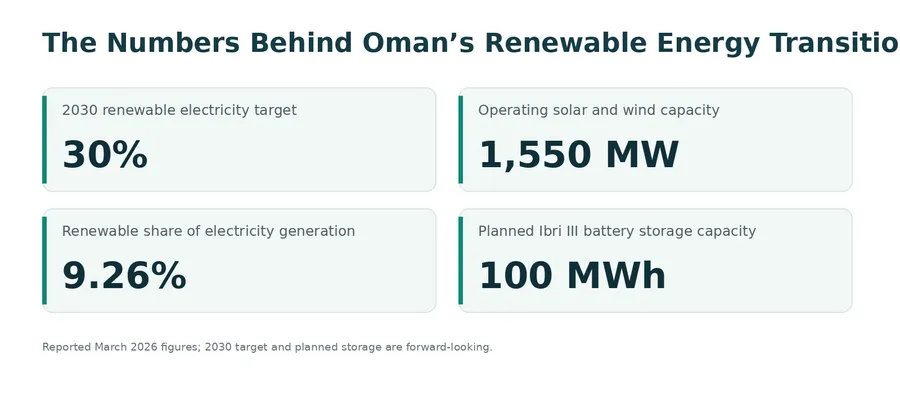
Source: Ministry of Energy and Minerals, March 2026. Project figures and commissioning schedules are subject to change.
Energy storage is emerging as a critical enabler of renewable energy integration.
Unlike conventional power generation, solar and wind resources cannot always be dispatched on demand. Battery energy storage systems (BESS), alongside other storage technologies, can help manage these fluctuations by absorbing electricity during periods of high generation and releasing it when demand increases.
For Oman, storage solutions could play an increasingly important role in supporting renewable deployment, particularly as solar generation grows and electricity demand peaks during hot summer months.
Battery storage can deliver several operational benefits:
Peak demand management: Reducing pressure on generation assets during periods of high electricity consumption.
Renewable energy integration: Storing surplus electricity and reducing potential renewable curtailment.
Grid stability: Providing rapid-response services to support frequency regulation and system reliability.
Infrastructure optimisation: Potentially deferring selected network upgrades where storage offers a technically and economically viable alternative.
However, storage deployment must be guided by clear commercial models, appropriate market frameworks and a comprehensive assessment of system needs.
The challenge is not simply to install more batteries, but to determine where storage delivers the greatest value across Oman's electricity network.
A more renewable electricity system also requires a more responsive and interconnected grid.
Oman's electricity infrastructure was historically developed around conventional generation, where output can be adjusted to meet demand. As solar and wind capacity expands, grid operators must increasingly manage variable generation while maintaining system stability.
This requires investment in advanced forecasting, automated grid management, transmission infrastructure, smart metering and demand-side flexibility.
According to Nama Power and Water Procurement's 2025–2031 planning statement, Oman is targeting approximately 30% renewable electricity generation by 2030. Achieving this will require renewable projects to be integrated alongside the country's evolving electricity demand and system requirements.
Grid flexibility can also create economic opportunities. More efficient use of renewable electricity can reduce dependence on gas-fired generation, improve system efficiency and potentially free up natural gas for higher-value industrial applications.
For energy-intensive sectors such as manufacturing, petrochemicals, desalination and emerging green hydrogen production, a reliable and increasingly low-carbon electricity supply could become an important competitive advantage.
One significant development is the planned Ibri III solar project, which is expected to incorporate battery energy storage alongside solar generation. Its proposed 100 MWh storage component represents an important step towards combining renewable generation with greater operational flexibility.
The economic case for renewable energy increasingly extends beyond individual project costs.
For Oman, scaling renewable energy can support several interconnected priorities: energy security, industrial competitiveness, emissions reduction, economic diversification and long-term infrastructure resilience.
Yet unlocking these benefits requires closer coordination between policymakers, utilities, developers, technology providers and investors.
Three priorities will be particularly important: developing commercially viable storage solutions, strengthening transmission infrastructure to connect renewable-rich regions with demand centres, and introducing market mechanisms that reward flexibility and system reliability.
The Authority for Public Services Regulation has identified battery energy storage and demand response management among its strategic initiatives, reflecting the growing importance of flexibility in Oman's electricity sector.
This transition also creates opportunities for innovation in artificial intelligence, predictive maintenance, digital grid management and energy forecasting. These technologies can help electricity operators anticipate demand, manage variable generation and optimise infrastructure performance.
The next four years will be critical in determining how effectively Oman translates its renewable energy ambitions into measurable outcomes.
Progress will increasingly need to be evaluated not only by megawatts installed, but also by the amount of renewable electricity delivered, the reliability of the grid, the effectiveness of energy storage and the economic value generated.
This calls for a shift in the energy transition conversation: from announcing capacity targets to demonstrating operational performance.
As Oman Sustainability Week (OSW) 2027 brings together policymakers, industry leaders, technology innovators and investors, the integration of renewables, energy storage and grid flexibility presents a timely opportunity for industry dialogue.
The discussions must move beyond what technologies are available to address how they can be deployed at scale, financed sustainably and integrated into Oman's existing energy infrastructure.
Oman's next energy milestone will not be defined by how much renewable capacity it builds alone, but by how intelligently it connects, stores and delivers that energy.
The transition from targets to implementation is already underway. The challenge now is to turn individual projects into a resilient, flexible and future-ready electricity system.